


-1761147112036.png)


Scientific research
Stefano Pluchino, the doctor from Ragusa who can eradicate multiple sclerosis
Having left Sicily at 18, he found his «happy place» in Cambridge (UK), where he is a professor of Regenerative Neuroimmunology. Italy? «It trains talents but doesn't know how to make them flourish, and it doesn't attract any from abroad»


«My happy place is Cambridge, England. My place of the heart is Cava d'Aliga, Sicily». Stefano Pluchino, Professor of Regenerative Neuroimmunology at the University of Cambridge, has no doubts. There is a geography of affections and one of professional fulfillment that, in the life of an emigrant scientist, rarely coincide. If the British university city is the place where he feels «safe» and where his career found fertile ground to develop without obstacles, in the seaside hamlet of Ragusa, feelings take center stage. It is there that he spent his summers as a child, among grandparents and cousins. «It is the place that makes my heart beat, the place of childhood memories, of things that stay with you for a lifetime». says Pluchino. But professional happiness, the daily life made of intellectual challenges and recognition, has a different postal address.
Pluchino's story is emblematic of a generation of Italian excellence. He left his native Ragusa at 18, in 1989, to follow a study path that took him first to Siena, then to San Raffaele in Milan, and finally to the United Kingdom. A trajectory not planned at a desk but guided by what he defines as a combination of luck and opportunities seized on the fly—the famous «sliding doors». These led him, in 2007, to win the Rita Levi Montalcini Award, assigned by the Italian Multiple Sclerosis Foundation (FISM) for his research on neural stem cell therapies that today promise to defeat that disease. Scrolling through the hall of fame, three names are linked by a common thread: Gianvito Martino in 1999, Stefano Pluchino in 2007, and Luca Peruzzotti Jametti in 2022. The master, the pupil, and the pupil’s pupil. Almost a «made in Cambridge» dynastic succession.
The reality, however, tells the story of the evolution of the scientist's profession itself. «My career wasn't planned at all, I wanted to be a doctor». says Pluchino, immediately dismantling the aura of predestination. «I had no one in my family to mentor me. The truth? Luck, both for Gianvito Martino and in my case». Those were different times, when raw talent, combined with what Pluchino colorfully defines as «a stroke of luck», could be enough to emerge. But with the third generation, represented by Peruzzotti Jametti, the tune changes radically. «Luca's award is all planned, obviously», he admits. A student at San Raffaele and a thesis student with Pluchino in 2007, Peruzzotti Jametti followed his mentor to Cambridge in 2014. From that moment, nothing was left to chance. In today's hyper-competitive academic world, the romantic approach doesn't pay. «You can't wake up and say 'I want to understand the causes of diseases' and leave it at that. You have to plan what to study, how to study it, if it is 'marketable', if it represents a real breakthrough or is just replicative science». The lesson is clear: today, to excel, talent alone is no longer enough.
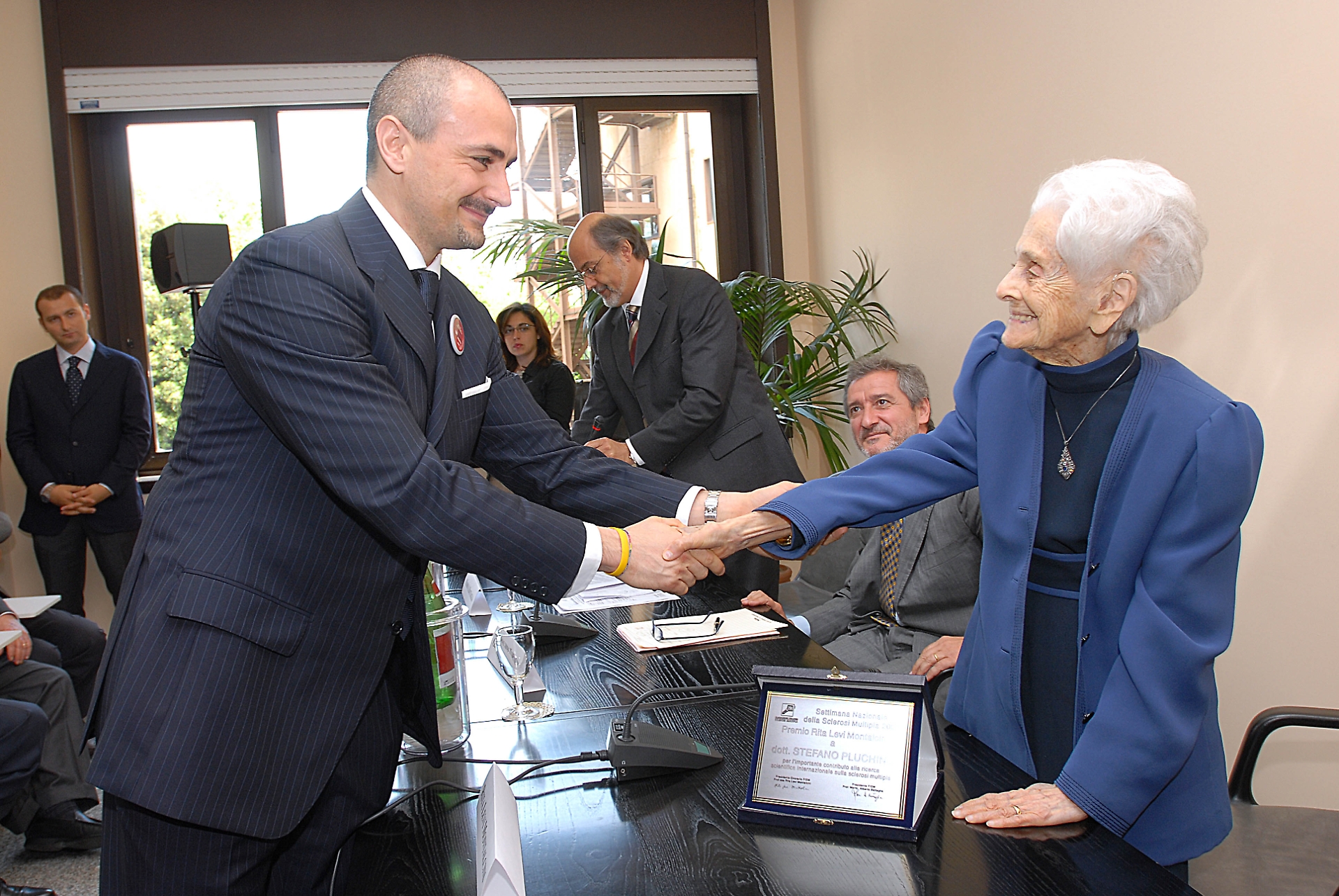
In 2007, Pluchino received the Rita Levi Montalcini Award, awarded by the Italian Multiple Sclerosis Foundation (FISM), from the Senator for Life herself.
And so, even the rhetoric of the «brain drain» collapses due to a logical fallacy. The professor's analysis of the academic and scientific system is almost ruthless. The problem, Pluchino argues, is not that Italians go abroad. «The problem is that for me leaving Italy, another one does not arrive», he explains. «If I go to the rector at Cambridge and tell him I'm leaving, he wishes me good luck because he already knows there is a line outside to take my place. In Italy, the system loses me and no one arrives to replace me with the same international profile.» Reciprocity is missing. «It should be a source of pride that an Italian scientist goes to flourish elsewhere, but the tragedy is that no one comes to flourish in Italy. There isn't a German, a Frenchman, or a Spaniard who wins a prestigious award working from an Italian university». The data confirms this view. Pluchino cites the prestigious grants of the European Research Council (ERC): «When the lists come out, we see that many Italians win. This shows that we aren't 'stupid'; on the contrary, we are as competitive as the English or Germans. But out of 15 Italians who win, 13 do so from foreign universities. The 'magic mix' of science is made by the individual's brain but also by the environment. Evidently, universities like Cambridge, Paris, or Groningen offer that ecosystem that is missing in Italy».
It is not just a question of facilities, but also of economic treatment and professional dignity. The salary comparison is pitiless. Pluchino recalls: «My paycheck in 2010 in Italy was very similar to today's. I recently met a colleague who remained at San Raffaele and he told me that in ten years it has increased by perhaps 50 euros. In England, the salary is five or six times higher». We are well over 10,000 euros, then, but the difference lies not only in the figure but in the model. In Italy, «the system seems to take for granted that an academic doctor must supplement their salary with private practice, visits, and consultations». However, «In England, private practice for an academic practically does not exist. The university gives you a salary that doesn't offend you and that justifies the work you do for the institution». If I have to look for sources of livelihood elsewhere, it is inevitable that I will work worse for the university.
Then there is a question of entrepreneurial mentality applied to research, for Pluchino a passage through the «Valley of Death»: that critical moment when translational research, which must move from laboratories to practical applications, is no longer supported by basic academic funds but is not yet ready for the market. «Abroad there is a structure ready to support this transition, with technology transfer offices that work. In Italy, they are starting, there are virtuous examples, but it is a mentality still to be fully built».
Yet, despite the critical issues of the system, the bond with his origins does not break. «Sicily cannot be erased, as Leonardo Sciascia said,» the professor admits. It is a visceral call that also involves the new generations. His son, raised between Milan and Bergamo and moved to Cambridge at 14, completed school in the UK and now attends university there. «Even for him, the place of the heart is Sicily. An absurdity, perhaps, but that's how it is.» Cambridge remains the «happy place», that of security and fulfillment, a city where history is breathed in every pub, like the one where Watson and Crick announced the discovery of the DNA double helix or one frequented by Pink Floyd. But Cava d'Aliga remains «the refuge of the soul». A dualism that perhaps will never be resolved, but which tells the condition of the contemporary scientist: a citizen of the world by necessity and talent, Sicilian by an inescapable law of the heart.