



-1761147112036.png)


SICILIANS
Salvo Arena, From San Berillo to Harvard: The American Rise of a Lawyer Who Never Gave Up
"The flow of US investment into Italy will continue to grow. The focus is on sports, real estate, manufacturing, and data centers."


“Never give up.”
The phrase, discovered almost by chance on a phone card in London and kept in his wallet for years, became a personal mantra as he pursued the American Dream — in a country that can either elevate ambition to its highest peak or discard it without hesitation. A place where everything is possible, “but where achieving it may mean working 62 consecutive hours in the office, without sleeping, changing clothes or stopping.”
From San Berillo, one of Catania’s most challenging neighborhoods, to New York, the professional journey of Salvo Arena, 57, Sicilian-born lawyer and managing partner of Chiomenti in the United States, reads like a novel. A story of determination, discipline and vision that could easily belong on a Hollywood screen. Widely regarded as “the dean of foreign lawyers” in New York, Arena received the prestigious Harvard Law School Award on April 4 — an honor previously bestowed on figures such as Barack Obama and Robert B. Zoellick, former President of the World Bank.
“One of the most important days of my life,” he says.
Education as a Path to Redemption
Arena’s early steps were taken in San Berillo, where opportunity was scarce. “My parents never had the chance to attend school, and especially for my father this was a lifelong regret. He always told me that education was the only way to improve oneself. That belief shaped me — the awareness that only studying could change my life.”
Books became the lever for what he describes as “a powerful sense of redemption.”
After graduating with honors in Law from the University of Catania, he won a scholarship and began his legal training under Professor Vincenzo Di Cataldo. But he soon realized that social and relational gaps were difficult to bridge. At the same time, he had long nurtured the ambition to pursue a master’s degree abroad, in a meritocratic environment offering broader opportunities.
He taught himself English, published academic work in commercial law during his PhD, completed an MBA with a scholarship, and — thanks to a loan of one million Italian lire from the mother of his then-girlfriend — submitted applications to Harvard, Columbia, Berkeley and Cambridge.
He was accepted by all of them. He chose Harvard.
Harvard and the Test of Meritocracy
“It was an extraordinary opportunity — but I didn’t have the $50,000 needed to attend.”
He refused to give up. Arena secured a one-year deferral from Harvard, won a research grant from the University of Catania, obtained financing from Comit, a student loan fund, received support from friends’ families, and even worked on archival research in Washington for the Museo dello Sbarco project commissioned by the Province of Catania.
Months of sacrifice followed — often misunderstood by family and colleagues. “They couldn’t understand why I would take on such debt when I was already an assistant professor in commercial law and starting my legal career in Catania.” That determination, he believes, can serve as inspiration. One of his long-term goals is to establish scholarships for talented students lacking financial resources.
In 1999, Arena became the first Sicilian to attend Harvard Law School. “I lived in the smallest room of the cheapest dormitory. It was a challenge. The level of the class was extraordinarily high — intellectually, socially and economically.”Meritocracy, he notes, remains a defining difference. “Legacy matters everywhere, including in the U.S. But in Italy, opportunities for those without connections are extremely limited. In America, merit still plays a decisive role.”
_(1)-1767128548245.jpg)
Attorney Salvo Arena as President of the Harvard Law School Association
From Wall Street to Cross-Border Strategy
After earning his degree, Arena joined Shearman & Sterling, one of the most prominent U.S. law firms. “Five days after getting married, I moved to New York.”
There, he learned a rigorous methodology, an obsession with quality, and an organizational discipline that convinced him New York was where he belonged — and M&A his professional calling.
Cultural mediation became central to his work. “My role often involves decoding and simplifying negotiation approaches shaped by profound socio-economic differences between Italy and the United States. Americans are more pragmatic, direct and utilitarian.”
Since joining Chiomenti in 2006, Arena has built one of the most respected Italian legal practices in New York.He was also among the first to anticipate American interest in Italian football clubs, advising on acquisitions including Bologna, Fiorentina, Cesena, Triestina and Roma, as well as stadium development projects. Beyond sports, his recent work includes high-profile transactions involving Marcolin, Illy Caffè, the IMA Group and the partnership between Teradyne and Technoprobe.
Looking Ahead: Investment Flows and Opportunity
Arena has remained deeply connected to Harvard, becoming the first non-American president of the Harvard Law School Association Worldwide, a role in which he significantly restructured the organization.
Is there a secret to his success?
“Luck helps, but obstacles are inevitable. What matters is absolute determination — and never giving up.”
Today, despite relentless work rhythms and constant travel between the U.S. and Italy, Arena sees growing opportunity. “U.S. investment in Italy has increased thanks to political stability, product excellence and the strength of family-owned businesses — ideal targets for private equity. At the same time, more Italian companies are looking to the U.S. market.”
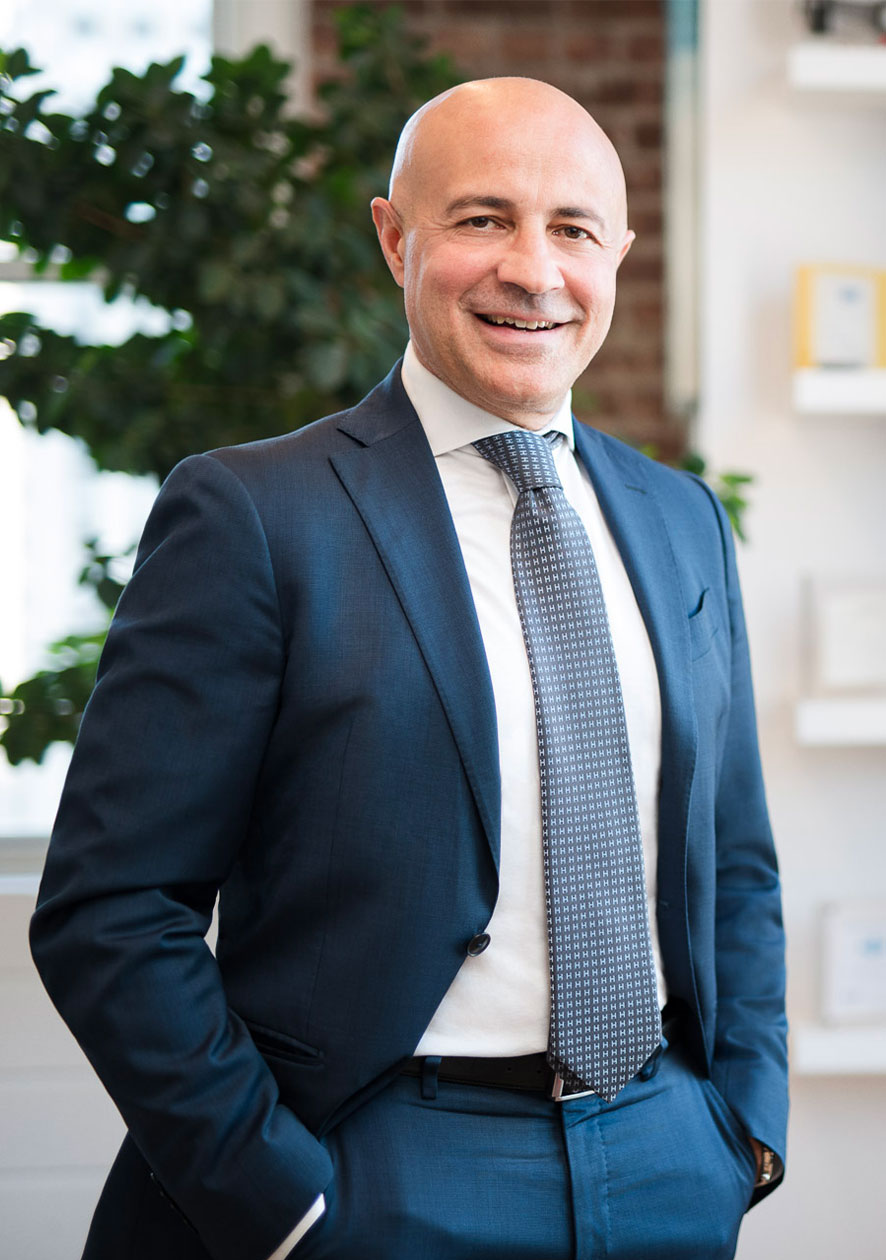
Lawyer Salvo Arena
The most attractive sectors?
“Manufacturing, real estate, hospitality, technology, energy — and especially data centers. I am convinced that investment flows between the U.S. and Italy will continue to grow in the coming years.”
Never give up?
“Total dedication,” he smiles. “My personal and professional lives are deeply intertwined. I love what I do.”