



-1761147112036.png)


SICILIANS
Luigi Caruso, The Fund Magician Who Envisions a Singapore-Style Sicily
A Milazzo native at the top of Blackstone, one of the world’s leading financial groups. “If I had a plan for Sicily: an open mindset and zero bureaucracy—pay, and the service arrives. I want to give back: I will return to my land what I’ve received.”
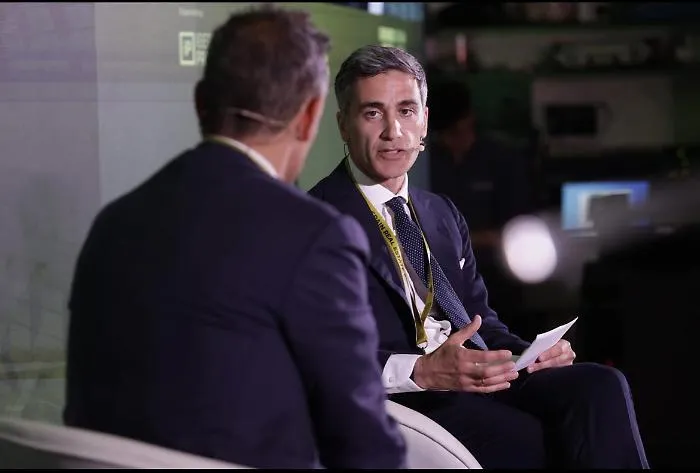

The line he repeats most during his conversation with La Sicilia, almost like a liberating mantra, is: “I’ve been very lucky.” Yet in Luigi Caruso’s success story, luck only goes so far. Proudly Sicilian, born in Milazzo, 44, he is a senior executive at Blackstone, a global giant in alternative investments with a focus on private equity and real estate—and more than a trillion dollars in assets under management.
It’s tempting—though he would likely disagree—to picture Caruso in his London office as if he were inside a modern-day arena: a thumbs-up (or down) can determine the fate of a multibillion-dollar deal. And yet, as the conversation unfolds, it becomes clear that the investment closest to his heart is a long-term one: “Going back to Sicily, doing something concrete for my land—giving it back what it has given me.”
A Milazzo Upbringing, A Global Trajectory
Caruso is the son of Nino, a tax accountant who “still works” and taught him that “there is no such thing as fixed hours—watching him work late into the night made me understand that certain outcomes require flexibility and sacrifice,” and Giusy, the “CEO of the home,” a full-time mother who raised Luigi and his sister Lydia, now a principal dancer with the Basel Ballet.
He speaks with pride of his classical high school education—often viewed as unconventional for someone headed into finance. “It gave me the ability to see things differently compared to the more standard approach of those who come from scientific training,” he says.Until 18 he lived in Milazzo—“where I still have a home and always return for holidays”—the permanent center of gravity of his life. “There are two things I love about my city,” he adds. “It’s a peninsula open toward the Aeolian Islands—historically more outward-facing than other areas—and it gave me a mindset capable of relating to anyone. At school you encounter tremendous social and cultural variety, and you understand what really matters. That was crucial for my career.”Then comes the time to pack his bags—though not cardboard ones. He moved to Milan to earn a degree and master’s in Economics at Bocconi University, before stepping into the global ocean of finance—without a life jacket.“I’ve been lucky,” he repeats, describing the turning points. But his timeline reads less like chance and more like readiness: being prepared, consistently, when opportunity appears.
From Landmark Deals to Global Platforms
Early on, at ABN AMRO, he worked on his first major transaction, advising Naguib Sawiris on the Wind operation—at the time, “the largest leveraged buyout in European history.” “For me, that was foundational,” he says.
That experience opened the door to Goldman Sachs. “From Milan I moved to London. I joined the M&A advisory team focused on Italy and worked on Prysmian, created as a Pirelli spin-off. That transaction was awarded ‘deal of the year’ for Goldman. We took the company public in Milan and executed several mergers. It was a milestone.”
He then shifted into private equity, moving to New York to work for Rhône Group, operating between London and New York. “I spent five out of six years in New York,” he notes. “I also followed WeWork from the very beginning, when it was a single office—long before it became a massive company.”
The current chapter is Blackstone. “I returned to London and joined Blackstone, where I focus on real estate,” he says. “Initially I led acquisitions for Southern Europe. Then I moved into a more central role: I became COO of the Asset Management team, with responsibility for the European portfolio—about €120 billion today. The next step: I was promoted to COO of Blackstone’s European real estate business.”
And the next frontier? “New York called me to lead acquisitions across Asia,” he says, describing a vast, fast-growing region with seven offices spanning Sydney, China, Japan, India, Korea and Singapore—and continuing expansion.
The ‘Give Back’ Thesis
This is the conventional story of a Sicilian who succeeds abroad: global mobility, elite institutions, high-impact roles. But Caruso’s mind—and heart—remain anchored to the island.
He is married to Afsaneh, an Iranian woman. “My dream is to go back to Sicily and build something special there, with her and my family,” he says.
He rejects clichés about “brain drain.” “I feel the times have changed,” he argues. “Speaking with Sicilians around the world, I see a strong desire to return and do something for a land that has given us so much. Historically, after the war, people left because there were no opportunities. Today, some opportunities exist. Of course, certain industries require specific hubs—my job can be done in only four or five European cities due to air and tech connectivity. But Sicily has many sectors to develop.”
Where Sicily Can Win
He points first to what he calls the “beauty industry”—tourism, hospitality and the island’s experiential economy. In his acquisitions work, he cites a partnership with the Mangia family involving Sicilian resorts. “Here’s an anecdote: when we sat down with British Airways, we managed to increase flights to Sicily thanks to the additional room capacity coming online,” he says.
He also notes the global demand shift—sparked in part by pop-culture exposure. “In the U.S. there’s a strong White Lotus effect, and we hope it lasts,” he says. “The last time I was in Taormina for an anniversary, my wife and I wanted to return to the Timeo, where we got married, but both that hotel and the San Domenico were rented for a month by fashion houses. I saw an astonishing number of Asian visitors.”
He hears comments on planes that make him smile: “Sicily is beautiful, it looks like Sardinia—who knew about the sea?” His response is unspoken but direct: look at the map. “After many years, this is really happening,” he says. “I’m optimistic about the trajectory. The key is not to force activities that make no sense, but to double down on local excellence.”
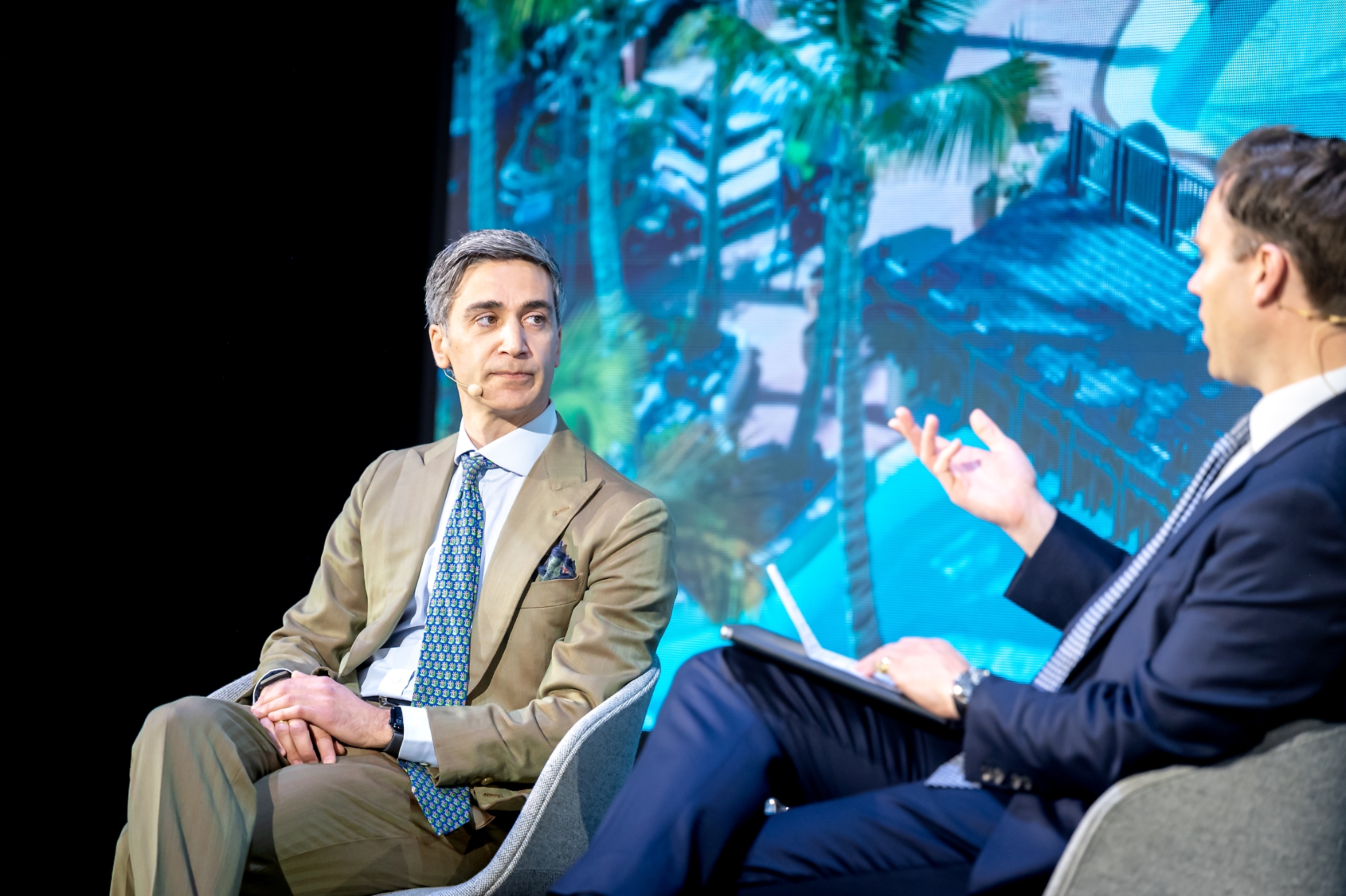
Luigi Caruso during an interview in the United States
Renewables, too, are a natural advantage—and so are less obvious sectors. “Marine cleanliness, for example, will become increasingly important,” he says. “As an island, we can attract global companies developing ocean-cleaning technologies. Sicily is an ideal territory to test and implement these innovations.” He also sees AI as a democratizing force that can reduce inefficiencies and help regions adopt more targeted strategies for attracting people and capital.
A Singapore Model: Less Paperwork, More Execution
Then he lands on the central point: investment. “Foreign capital is essential,” he says. “You need investments attracted by projects that enhance the territory.”
He points to areas already functioning well—Noto and its surroundings. “I have a dozen friends with no ties to Sicily who have bought homes there and spend holidays there. They bring a different standard of living.” Events follow: destination weddings, higher-value tourism, and new entrepreneurial interest. “People discover Sicily, fall in love, and stay,” he says. “Now you often hear: ‘I’d like to buy land and start a winery,’ ‘I’d like to produce olive oil.’ It’s a rediscovery of the territory.”Asked to outline a business plan for Sicily, Caruso is precise: “It starts with openness to the world and a regulatory framework that creates a virtuous cycle. We’re an autonomous region with a certain degree of flexibility: if we make the right decisions, we can gain an advantage over other places in Italy. And Sicily benefits from the broader ‘Italy system’—a country seen much better abroad over the last five years for stability and other factors. Excellence within a functioning system yields additional competitive benefits.”
His preferred benchmark is personal—and immediate. “I’m moving to Singapore,” he says. “The island is smaller than Mallorca, a fraction of Sicily, yet it has two of the largest sovereign wealth funds in the world investing everywhere. How did they do it in just fifty years? They built a system that works: bureaucracy is almost absent, it’s a service economy—pay, and the service arrives.”
His prescription is blunt: “You have to cut paperwork—not only bureaucracy, but also the apparatus of officials who often block instead of enabling. The focus should be: what can we do so that anyone coming to Sicily can actually do what they want to do?” The most effective incentives, he adds, are not broad subsidies but fiscal incentives tied to investment and long-term concessions that can justify patient capital. “If leadership sits down with those bringing investment, the recipe is straightforward—and effective.”
Beyond Returns: Legacy
At the end of the conversation, the executive thesis intersects with something more personal: family. “The bond my children have with Sicily is fundamental to me,” he says. “We go on holiday there, we have a home, we cook. And they speak fluent Italian. I want them to understand the values I come from and feel the connection to our land.”
And then comes the promise—without emphasis, but with clarity: the urge to give back. “Those of us who have seen the world know what works and what doesn’t,” he says. “The privilege would be implementing what makes sense in Sicily. Among friends in New York, London, Singapore, Dubai, we often say: ‘It would be great to bring this there.’ I’m 44—I still have time before I can truly redirect my life in a substantial way. But I already feel the desire. And it’s not just mine; I see it in many people.”Time is the missing ingredient, he concludes. “Ideas exist. Sometimes we try. But you need time to dedicate yourself properly. We will do it. I will do it. Because everything has to be done at the right time.”
And it won’t be a matter of luck.