



-1761147112036.png)


SICILIANS
Francesco Testa, a Borderless Public Prosecutor Taking on Criminal Networks
Appointed in June as Deputy Head of Italy’s Desk at Eurojust in The Hague, he has built an international career after many years at Catania’s Anti-Mafia Directorate
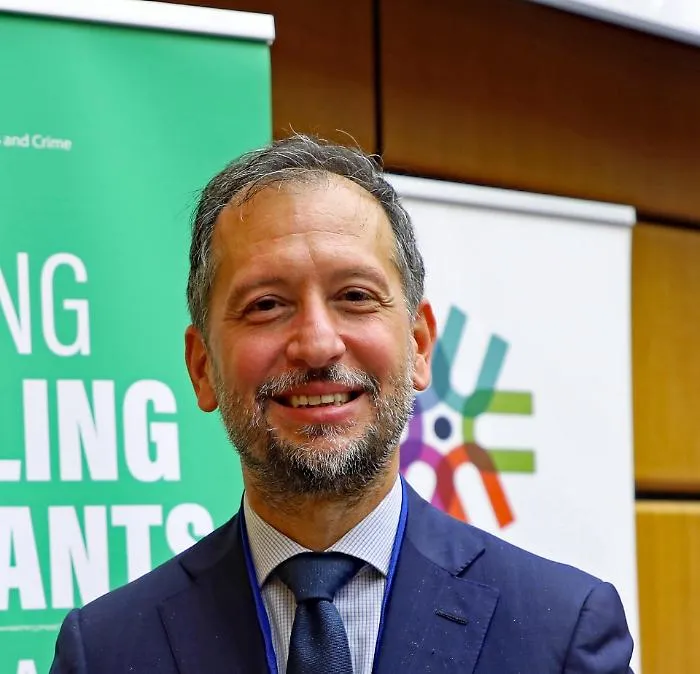

Never forget where you come from. Origins should never be a limitation, but a starting point for new opportunities. Francesco Testa is firmly convinced of this. A magistrate proudly Sicilian—Catanian, to be precise—he has always been drawn to travel in its broadest sense. His decision to join the judiciary was driven by passion and vocation. “The Capaci and Via D’Amelio bombings happened. Life changes,” Testa says quietly.
That calling has taken him, as of a few months ago, to The Hague in the Netherlands, where he now serves as the second-in-command of Italy’s office at Eurojust. Working in Europe’s judicial capital is not an endpoint but a stage in a career that has consistently looked beyond the borders of any single city—or region.
Born in 1971, Testa began his career in late 1998 at the Catania courthouse in Piazza Verga. “It was my first posting,” he recalls. “I spent about 14 years there, eight of them at the District Anti-Mafia Directorate.” During that period, often alongside the mobile police squads, he worked on investigations into organized crime, money laundering, drug trafficking and arms smuggling. “Even then,” he notes, “any investigation of real significance inevitably had an international dimension—particularly narcotics trafficking involving South America and Northern Europe.” It was there that his interest in judicial cooperation tools took shape.
In 2012, after coordinating an operation that prevented a potentially devastating mafia war and leading the investigation that captured long-time fugitive Giovanni Arena, Testa left Catania. His next stop was Rome, at the Ministry of Justice. “I spent a brief period in the Minister’s Cabinet, then moved to Vienna to Italy’s Permanent Mission to the United Nations, where I worked on international cooperation on a global scale.”
Austria was followed by his appointment as Chief Prosecutor in Chieti, Abruzzo, and then another international role: the European Public Prosecutor’s Office in Rome. He remained there until June, when he was appointed Deputy to Italy’s National Member at Eurojust.
An Operational Hub, Not a Desk Job
Eurojust, Testa explains, offers a unique platform for effective international cooperation by supporting criminal investigations across all EU member states. “It’s a mistake to think these are purely organizational roles,” he says. “We investigate—just with a broader lens.” The work includes executing European Investigation Orders, confiscation orders, mutual legal assistance requests and the full range of cooperation instruments provided by international conventions.
While most cases are initiated at the request of national authorities—Italian prosecutors among the most active—Eurojust can also act on its own initiative. Experience in a district prosecution office like Catania’s, Testa adds, is invaluable, especially in combating mafias that can no longer be understood as territorially confined. “Every day we uncover criminal connections that are entirely unexpected yet deeply rooted both within and beyond the EU.”
Financial hubs, he notes, are particularly attractive to organized crime seeking to launder illicit proceeds. Here, Eurojust’s role becomes essential, applying Giovanni Falcone’s method—follow the money—to reconstruct the laundering chains. New risks have emerged with the uncontrolled spread of cryptocurrencies, an area where Eurojust now operates directly. “Our operational portfolio is very broad,” Testa says. “That includes crypto-assets.”
A Bridge Between Prosecutors
Eurojust functions as a true operational bridge between prosecutorial offices. “We channel requests from Italian prosecutors abroad and from foreign authorities to Italy,” Testa explains. “The most interesting part of my work is this dual role—assisting Italian offices in dealing with other countries, while simultaneously supporting foreign authorities in their relations with Italy.”Coordination unfolds in stages: initial contact by phone or email, followed by feasibility assessments with the relevant national desk, then preparatory coordination meetings with the competent authorities. Eurojust also serves as a point of synthesis among differing legal systems. “Tensions and differences between legal frameworks do arise,” Testa acknowledges. “Our task is precisely to overcome them, safeguarding the effectiveness of investigations.”
Over time, Eurojust has evolved well beyond its original mandate. While founded to support cooperation among EU countries, it now hosts liaison magistrates from non-EU states as well, expanding its geographic reach. “We have liaison prosecutors from the United States, Iceland, Albania, Montenegro and Georgia,” Testa notes. “Next year we expect colleagues from Algeria and Colombia, and the United Arab Emirates has also expressed interest.” For narcotics investigations in particular, he adds, “the presence of a Colombian magistrate will be operationally invaluable.”
A Sicilian in the World
Professionally demanding as it is, the role has also been enriching on a personal level. Life in The Hague, Testa says, is stimulating: international, multicultural, with a high quality of life. “As a Sicilian, I deeply love my land, but I’m comfortable abroad as well. I travel constantly, yet I always like to return to Sicily.”
How does he define himself today? “A Sicilian—a Sicilian in the world.” A father of two, he carries that identity into his work. “Sicilian culture, identity and history are appreciated everywhere,” he says with pride. “And I can say without hesitation that Catania was an exceptional training ground for doing this job.”
Holidays? “Work comes first when necessary,” he says. “But this year, I hope to spend Christmas with my family.”