



-1761147112036.png)


SICILIANS
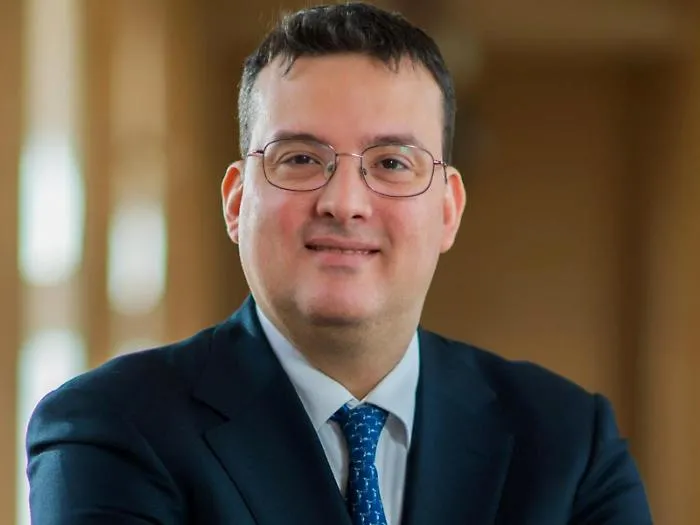
Roberto De Meo, the Messina-Born Global Executive at Visa Inc.: Today His Responsibilities Span Nearly 90 Countries
From Messina to Dubai, with a degree from Bocconi in Economics of Institutions and Financial Markets, at nearly 50 he serves as Vice President at the world’s leading payments company, overseeing advisory and data analytics functions“He’s always been a genius—both for better and for worse.”

Giuseppe recalls Roberto this way, smiling. They were classmates at Messina’s classical high school La Farina and lifelong friends.
Today, as he approaches 50, Roberto De Meo is a Vice President at Visa Inc., the world’s leading payments network, within Visa Consulting & Analytics. His responsibilities span nearly 90 countries across Central and Eastern Europe, the former Soviet Union, the Middle East and Africa. His work focuses on some of the most pressing themes in global finance: artificial intelligence, cybersecurity, digital transformation, and operational and credit risk.
“When I was a child,” he says over the phone, while on vacation with his wife Anna and their two children, Marko and Luka, “I dreamed of a job, a family—and of being able to travel. I never imagined I could become an international executive.”
Yet that is precisely what happened. From Messina, Roberto left immediately after high school, inspired by his parents Lorenzo and Maddalena—both retired university professors, in Demography and Pathological Anatomy—moving to Milan in September 1994 to attend Bocconi University. He graduated cum laude in February 1999 in Economics of Institutions and Financial Markets.
Yet that is precisely what happened. From Messina, Roberto left immediately after high school, inspired by his parents Lorenzo and Maddalena—both retired university professors, in Demography and Pathological Anatomy—moving to Milan in September 1994 to attend Bocconi University. He graduated cum laude in February 1999 in Economics of Institutions and Financial Markets.
“I chose Milan to expand my career opportunities,” he explains. “Initially, I wanted to become an aeronautical engineer, but during the summer of my final exams I learned—almost by chance—about this new degree program.”
Milan became his base for 15 years. After graduation, he joined Bain & Company, the U.S.-based strategy consulting firm, where his career progressed from analyst to associate partner. His areas of specialization were financial institutions—his primary focus—and air transport, a passion from his teenage years that never faded.
Still with Bain, from 2010 to 2015 he lived and worked in Moscow, with a six-month stint in Bangkok. From 2015 to 2017, he was based in Madrid, splitting his professional time with London.
In December 2017, De Meo joined Visa Inc., returning to Moscow to build a consulting function dedicated to digitalization. Four years later, he was promoted to Vice President—his current role—expanding his responsibilities and relocating to Dubai, where he now lives.
Over the course of his career, De Meo has lived in five countries (Italy, Russia, Thailand, Spain and the United Arab Emirates), worked in more than 25 countries, and speaks five languages: Italian, English, Russian, French and Spanish.
“The sixth is Messinese,” he jokes, “which I struggle to keep in practice in Dubai—although I try to pass it on to my children and occasionally even to my colleagues.”
Wherever he has lived, he has managed to integrate and build lasting relationships, helped by an affable and open nature.
“In about 90% of cases,” he says, “being Sicilian has been met with affection and curiosity. Of course, there have been stereotypes and the occasional mafia joke. The keys to living well abroad are two: humility—because you are always a guest and must respect local rules and traditions—and curiosity, which allows you to understand those traditions and, at times, make them your own.”
“In about 90% of cases,” he says, “being Sicilian has been met with affection and curiosity. Of course, there have been stereotypes and the occasional mafia joke. The keys to living well abroad are two: humility—because you are always a guest and must respect local rules and traditions—and curiosity, which allows you to understand those traditions and, at times, make them your own.”
He notes how often he has found unexpected similarities with Sicily. “Our island has been a crossroads of cultures for centuries. Perhaps that’s why, wherever I’ve gone—from Eastern Europe to the southern Mediterranean—I’ve always found something familiar. In Eastern Europe, despite a seemingly different communication style, there is strong emphasis on human relationships. On the other side of the Mediterranean, cultural parallels are striking. Ultimately, it’s easier than one might think to connect and integrate.”
Outside of work, De Meo is highly active within the Bocconi alumni community. From 2018 to 2022, he led the Bocconi alumni network in Russia; today, he is one of the senior leaders for the Gulf countries. Driven by another passion with distinctly Sicilian undertones, he also founded a social media group for food lovers, now bringing together 2,600 members from over 50 countries who exchange recommendations and experiences.
Still, something is inevitably missing.
“My parents, without a doubt,” he admits. “And the sea. Even though I live in Dubai, nothing compares to Torre Faro, where our family home is. It’s the best.”
Each summer he manages to return for about a month, immersing himself fully—granite di caffè con panna included. What he misses most, however, is the disappearing tradition of home cooking: Christmas Eve pasta with spices and breadcrumbs, New Year’s sartù of rice, pasta and beans col quagghiu, and bread with “assassinato” tomato sauce that he ate as a child.
As a teenager, De Meo competed in fencing at an elite level with the Messina Scherma Association, earning several regional and interregional podium finishes. It’s a sport he still follows closely—also through Visa’s role as an official sponsor of the Olympic Games.
Asked what advice he would give young Sicilians aspiring to an international career, his answer is unequivocal.
“We have so much to give,” he says with pride. “We shouldn’t be afraid to take risks, even to leave the island to explore new opportunities and open ourselves to the world. Home will always be home—and it will always be there waiting.”
To his children, Marko and Luka, he already knows what he will say:
“Never stop dreaming. Life will be difficult, but nothing can stop your dreams.”
His final thought returns to his school, the Giuseppe La Farina classical high school.
“The greatest memory I can share is my debt of gratitude to my school—its teachers, first and foremost the principal Pio Lo Re, who passed away a few months ago—and my classmates. Those difficult adolescent years were fundamental in shaping me as a person and supporting me in moments of hardship.”
On the school wall, there was once an inscription, now faded by time:
Hic regnavimus, hinc eximus, sed noster animus manebit semper hic.
“Here we ruled, from here we departed, but our spirit will remain here forever.”
© RIPRODUZIONE RISERVATA